artlooklearn.com

menu icon
go to homepage
  • All Lessons
  • About
  • Contact
    • Facebook
    • Instagram
    • Pinterest
    • YouTube
  • search icon
    Homepage link
    • All Lessons
    • About
    • Contact
    • Facebook
    • Instagram
    • Pinterest
    • YouTube
  • ×
    Home » Beginning Drawing Lessons Online » How to Draw a Skull Step by Step

    How to Draw a Skull Step by Step

    Learn how to draw a skull step-by-step in this easy tutorial. In this simple online art class find out how to sketch a realistic skull in pencil.

    A perfect art lesson for beginners or advanced artists, this lesson easily teaches how to draw a skull one step at a time. It is fun to practice drawing a human skull and explore new art skills and techniques at the same time.
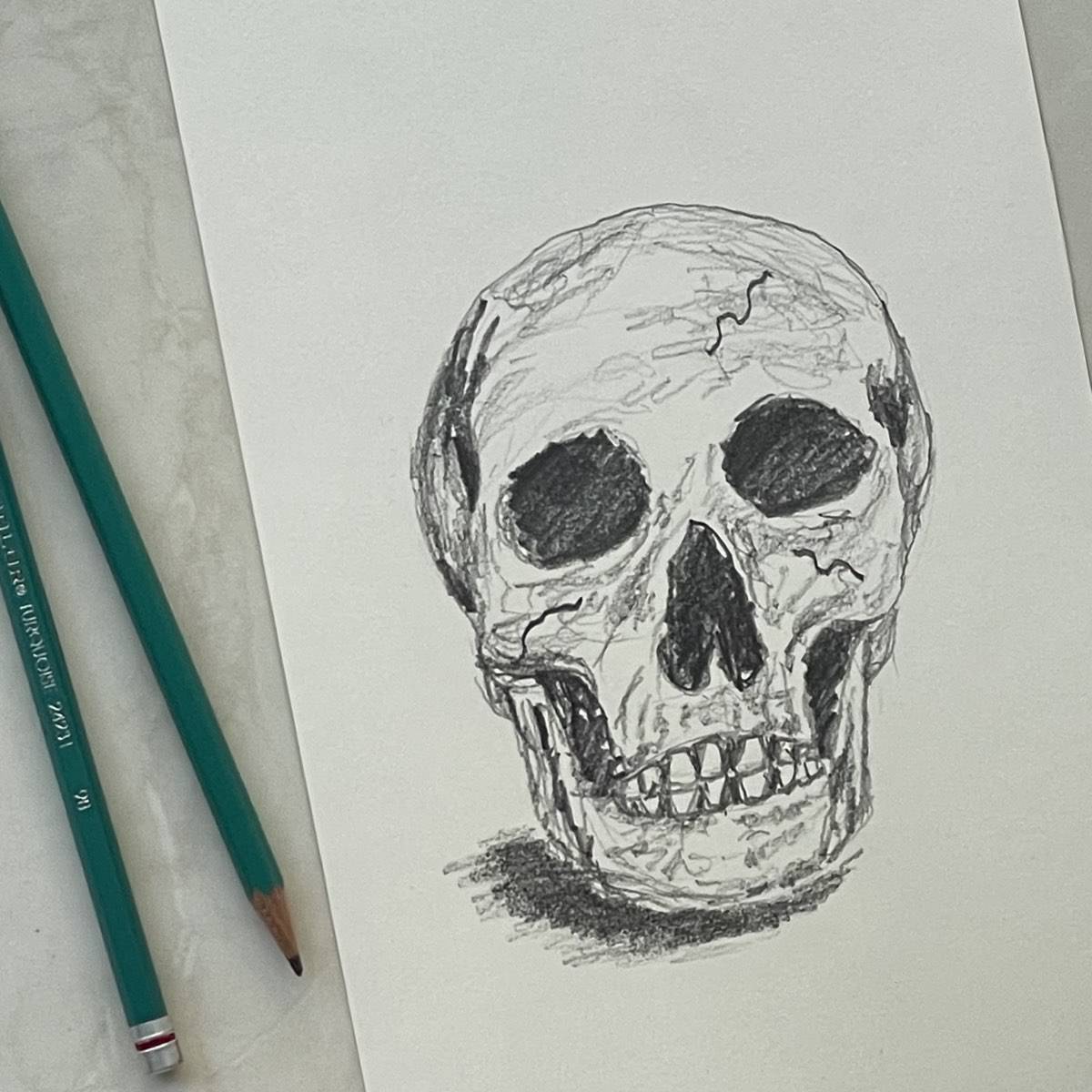
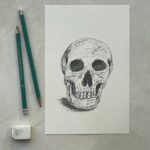
    Drawing of a skull in pencil next to artist drawing pencils and an eraser.
    Jump to:
    • Materials
    • Drawing a Skull Video Tutorial
    • Transcript
    • How to Draw a Skull Step by Step
    • Tips and tricks
    • Detailed Instruction Card for Drawing a Skull
    • For More Practice
    • How to Download an Image from the Internet
    • Frequently Asked Questions
    • You also might like

    Drawing a human skull might appear to be complicated, but when broken down into easy-to-follow steps, it is not as difficult as it seems. Discover the basics of how to draw a 3d skull, add texture, and shade it.

    Whether it is just in time for Halloween, the Day of the Dead, to celebrate the fall season, thinking about Shakespeare, or for the love of human anatomy, learning how to draw a skull is an important skill to practice.

    Just follow the directions to get started sketching a skull quickly and easily. 

    Check out more beginning drawing lessons and watercolor painting classes.

    Materials

    • Pencils (HB for 2B or light sketching and 9B or other soft, dark pencil for shading)
    • Paper  - 70 pound / 115 gsm. drawing paper 9 x 6 inches (or use whatever you have on hand)
    • Eraser - White Vinyl or other

    Drawing a Skull Video Tutorial

    Transcript

    Read Transcript
    Hi everyone! Let's get started drawing a quick and easy skull in this art lesson. 

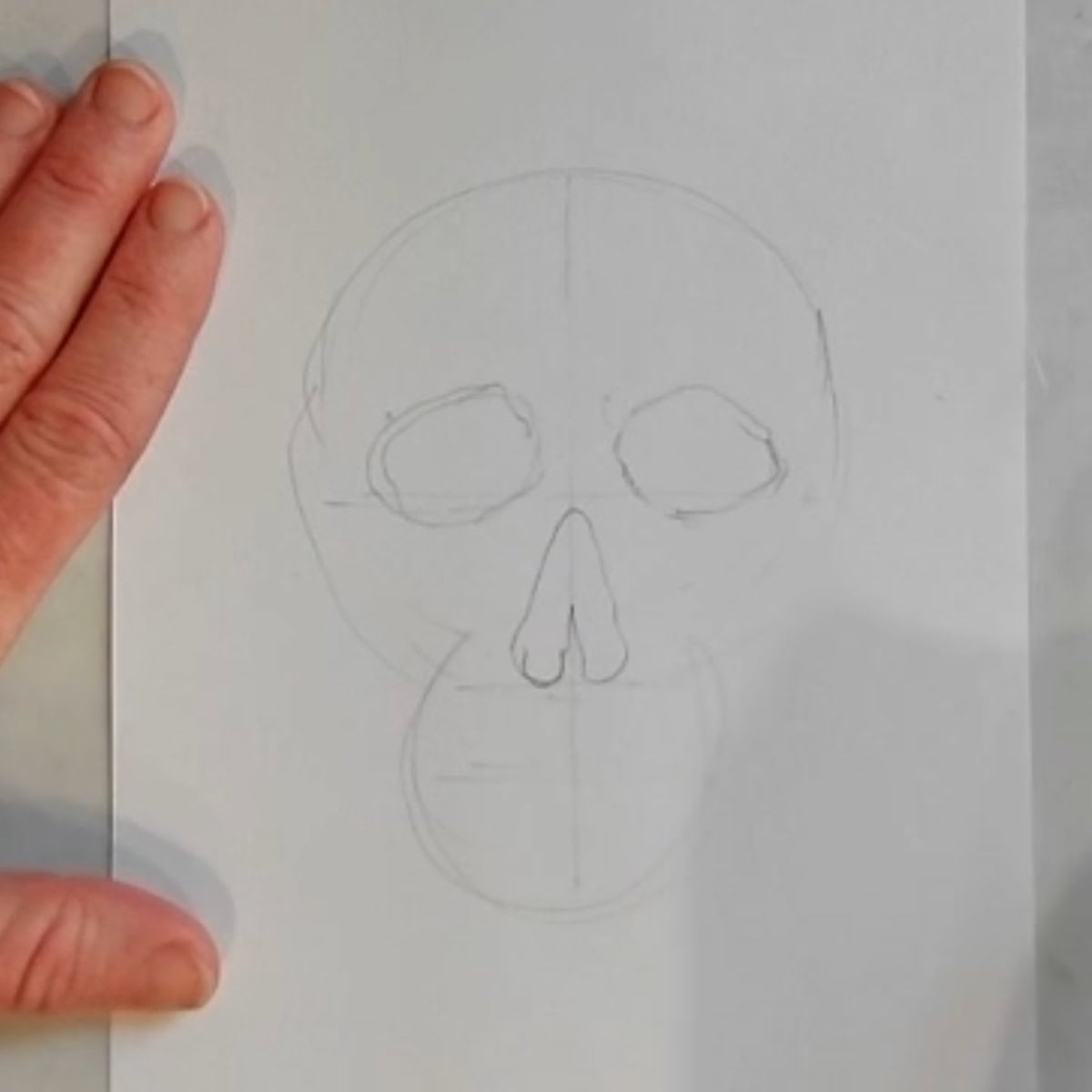
    Start by drawing a circle and then another circle down below that, with the two circles overlapping.

    It's okay if they're not perfect don't worry about that very much right now. And then erase where they overlap.

    I'm going to draw a guideline right down the middle and then about from halfway to the bottom to top another guideline where the eyes will be and halfway and halfway where the nose and then the mouth will be.

    I'm just going to sketch in the eye sockets and they are kind of oval shapes but they're tipped on the side a little bit so they're not, they're not circles and they're not they're not rectangles. They're just kind of these ovals but they're tipped to the the sides a little bit.

    Again don't worry if it's not very perfect, I'm going to make this skull really nice and sketchy and loose and so it doesn't matter if things are just off a little bit. 

    Sketch in the nose. The nose is kind of like an upside down heart shape and it's rounded at the top but leave that little, the septum that goes down the middle of the nose that separates the two nose cavities, leave it there and we'll leave it white. 

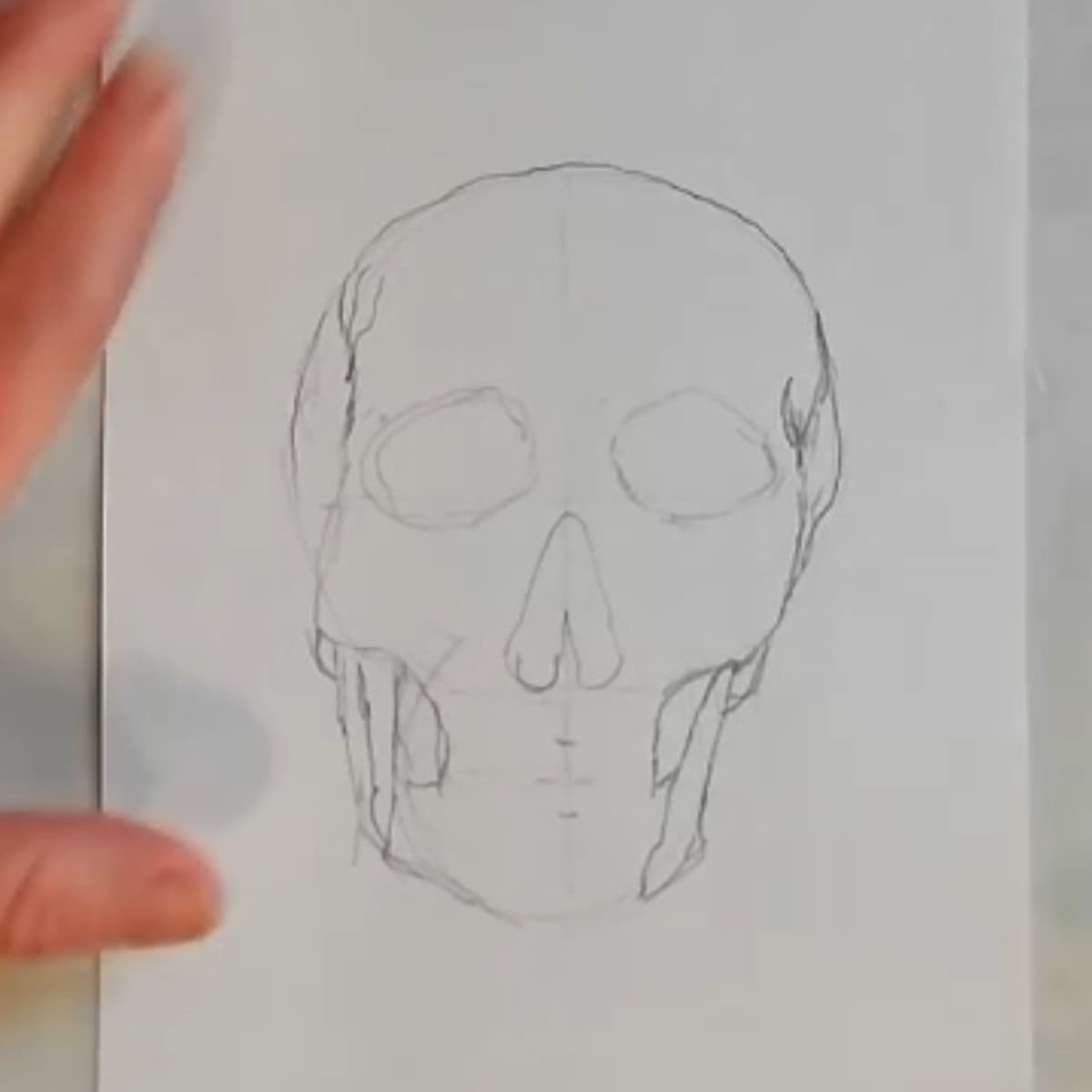
    I just sketched in the mouth and I'm going to come back to that later on and add more detail to the mouth. Now I'm defining these bones, the face bones, the cheekbone, it's going to come down and right around where the nose, the base of the nose is is where these cheekbones are going to kind of swoop in and then go down and meet the jaw. 

    Now I'm drawing in the back of that jaw and then it's going to kind of come down and meet the chin, the other side of the back part of the jaw. Remember that whole back part of the jaw, like the chin and the back jaw move, whereas the top teeth and the top of the skull are all one piece. All right so [draw] the back part of this jaw on the other side.

    Notice my drawing is not one hundred percent symmetrical and that's okay. A lot of times when they photograph skulls they're off a little bit one way or the other so if you want to go ahead and make your drawing really symmetrical feel free to do that. I'm just drawing a skull I found off the internet. 

    Now I'm adding a little bit more detail to the top. Right behind the I sockets there's a little divot where the um skull kind of sinks in, so I'm going to be drawing in a shadow behind that area. 

    There, just going ahead and kind of defining those areas and defining the top of the skull a little bit more clearly. Erase the guidelines that you don't need. Leave the ones in the mouth because we're still going to go back in and do the mouth.

    That is where the center of the mouth is. That is the top row of teeth and then the bottom row of teeth. The top row of teeth is going to be a little bit taller and bigger than the bottom row. Maybe I can fit in three or four teeth there across the front on each side. And the top part of the tooth is a little bit skinnier than the bottom part.

    Just drawing in each tooth, one at a time. As the teeth go back into the jaw they're a little bit smaller. This is due to perspective so make sure to make them smaller as they go back. 

    The bottom teeth are a little bit smaller than the top teeth and they're also going to sit behind the top teeth. I'm actually not drawing the top of these bottom teeth I'm just letting them sit behind the top teeth.

    Then you can go in and add a little bit of shadow between the teeth. 

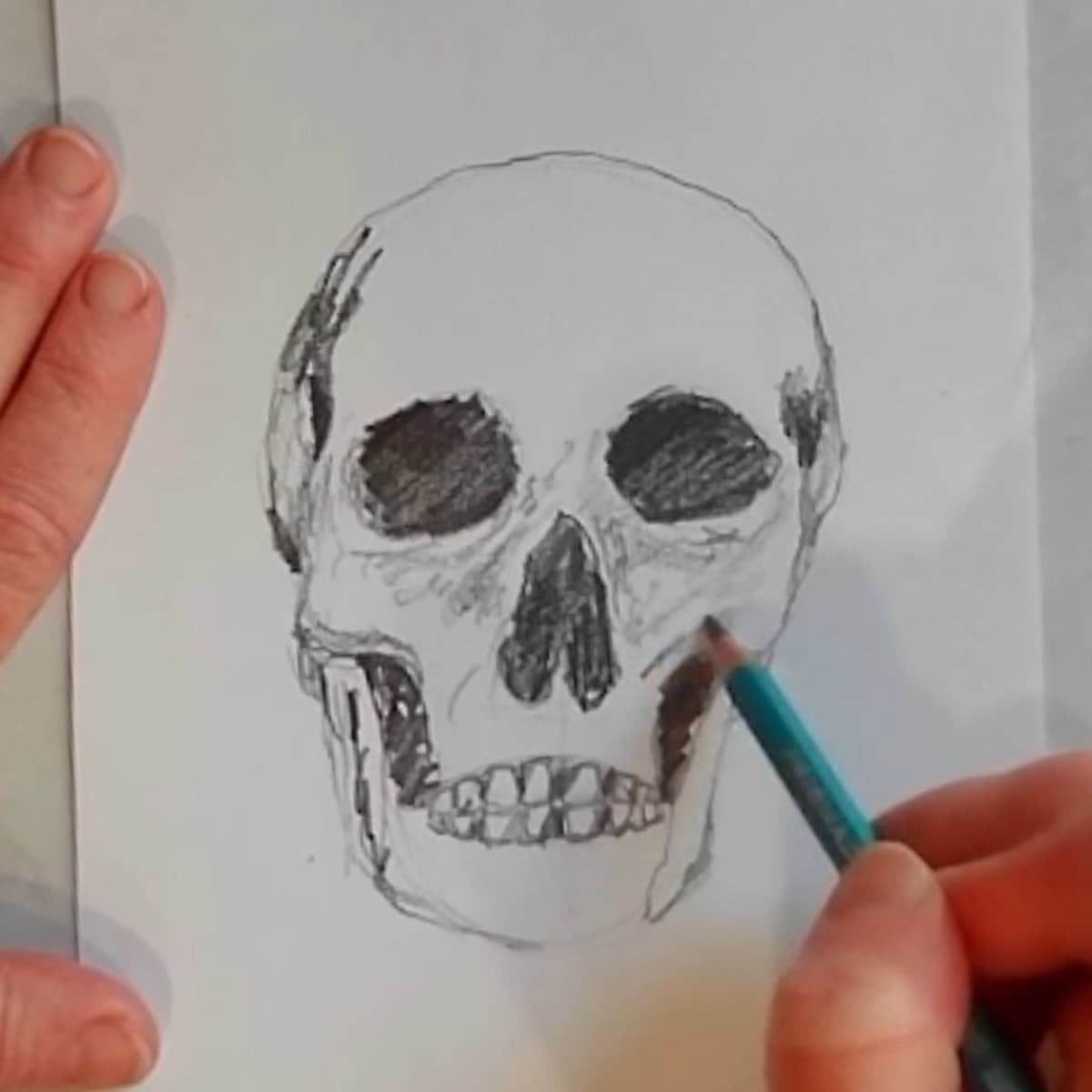
    Now I've switched to a softer pencil. This is a 9B it's just about the softest, darkest pencil you usually come by so I can get some nice dark, dark areas really quickly. 

    Keeping my lines nice and loose and sketchy, just doing some quick hatching to sketch in and get some nice shadows in here. This area where, between the jaw and then the front, that's going to be nice and dark as well.

    I'm trying to work the drawing overall. I'm not putting a whole lot of detail into one area over another I'm working the whole drawing all at once. 

    After I've gotten all this, the kind of the basic sketching and shading in, I'm going to go in and add a little bit more detail. Still keeping my lines nice and loose and sketchy, a little bit more detail into the back jaw.

    A little bit more darkness in the eye sockets there, in some of the area.

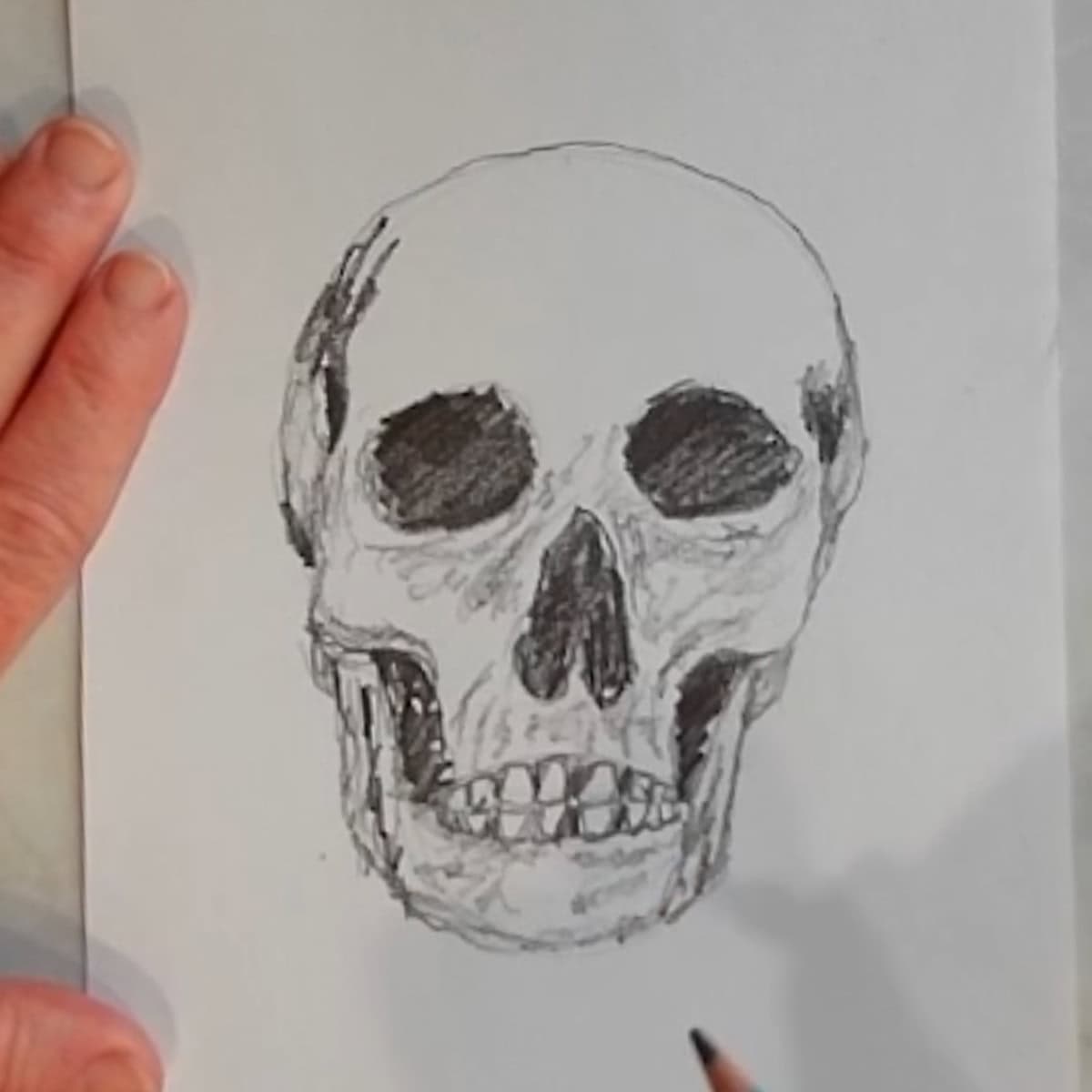
    Working on the front part of the skull just kind of adding in some texture some nice scumbley lines. Keeping my lines nice and loose and adding in more detail and more definition as I go along.

    On the other side, kind of repeating the same idea, getting some texture and a little bit of shading in with these nice loose sketchy lines.

    It can be really helpful if you did want to go online and get a picture of a skull and work from that or you can just go ahead and draw along with me. I'm adding a little bit of shading where the teeth go into the top there and at the bottom as well.

    Also, keep in mind that with your shading you want the shading to not be too dark in the background because dark, darker values tend to come towards you. 

    You want to make sure that the, the area, the back part of the jaw and the back part of the skull where it's starting to go back into space, you don't want those areas to be too dark because then it might feel like it is trying to come towards you instead. 

    You want those areas to be a little bit shaded but not too dark. I'm making sure that my darkest areas are the eye sockets the nose socket and then the area right between the jaw. 

    Again some nice loose sketchy detail right there up at the top of the skull, getting some texture, a little bit of value with these nice sketchy loose lines.

    That's basically it. Now is a really good time to look at your overall drawing and if any areas need to be lightened up a little bit I could go in and use the eraser on them. 

    If any areas need to be darkened up I can go in and add a little bit more shading in. Add any more detail where I would like a little bit more detail. 

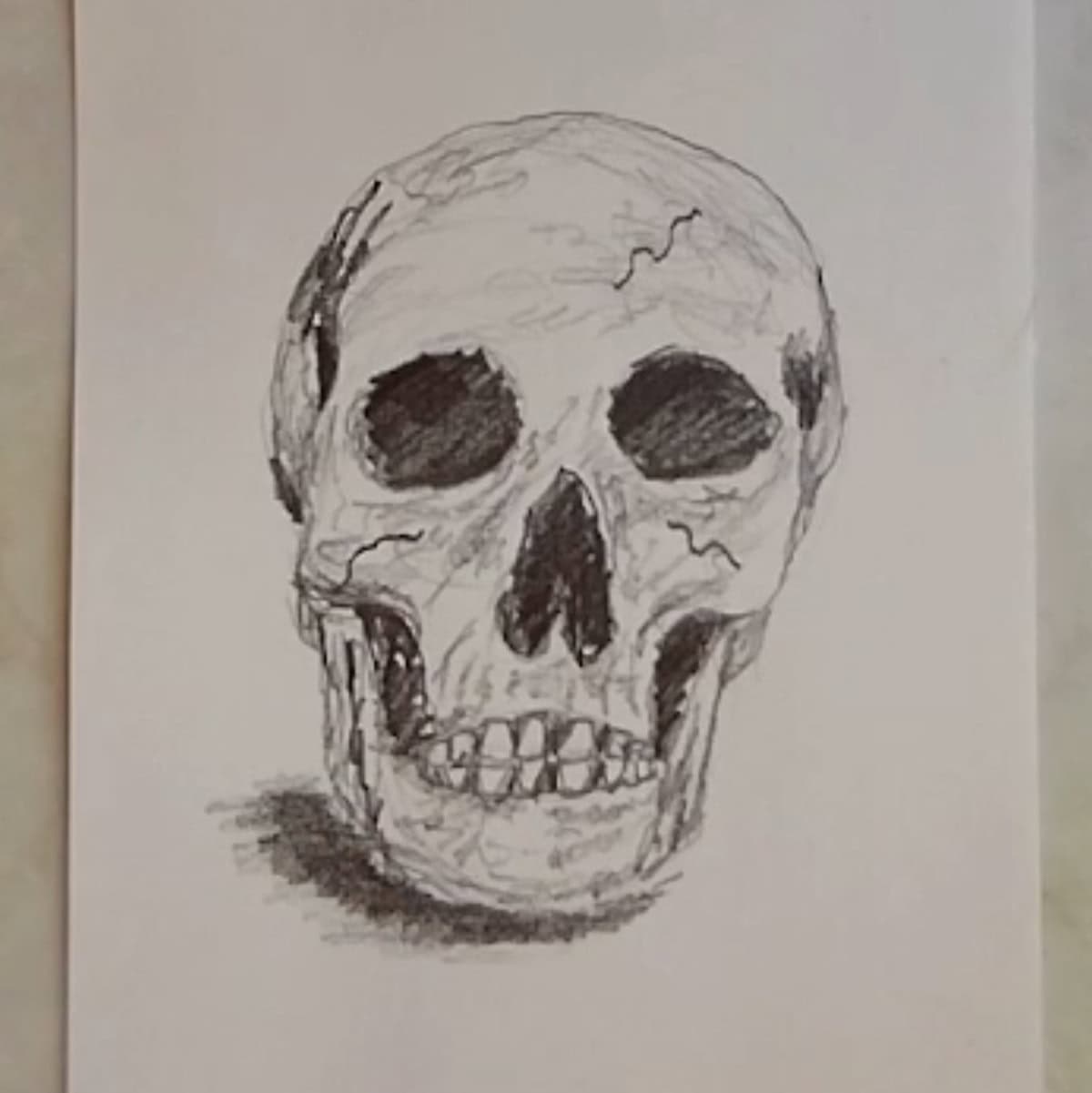
    Here I'm going to add just a little crack, this is optional but it's kind of fun, it's kind of spooky, gives a little bit of, gives a little bit of atmosphere to your, your skull drawing. Makes it nice and fun. 

    Lastly, I like to add a little shadow, just a little bit but make it nice and dark so that we get a sense that this skull is sitting on top of something, like it's not floating around in space. It's maybe on top of the ground or a table or whatever it is.

    Then go ahead and go in and just soften up the edges of that shadow. 

    That's basically it. Thanks for watching.

    How to Draw a Skull Step by Step

    Sketch the basic skull shape and guidelines
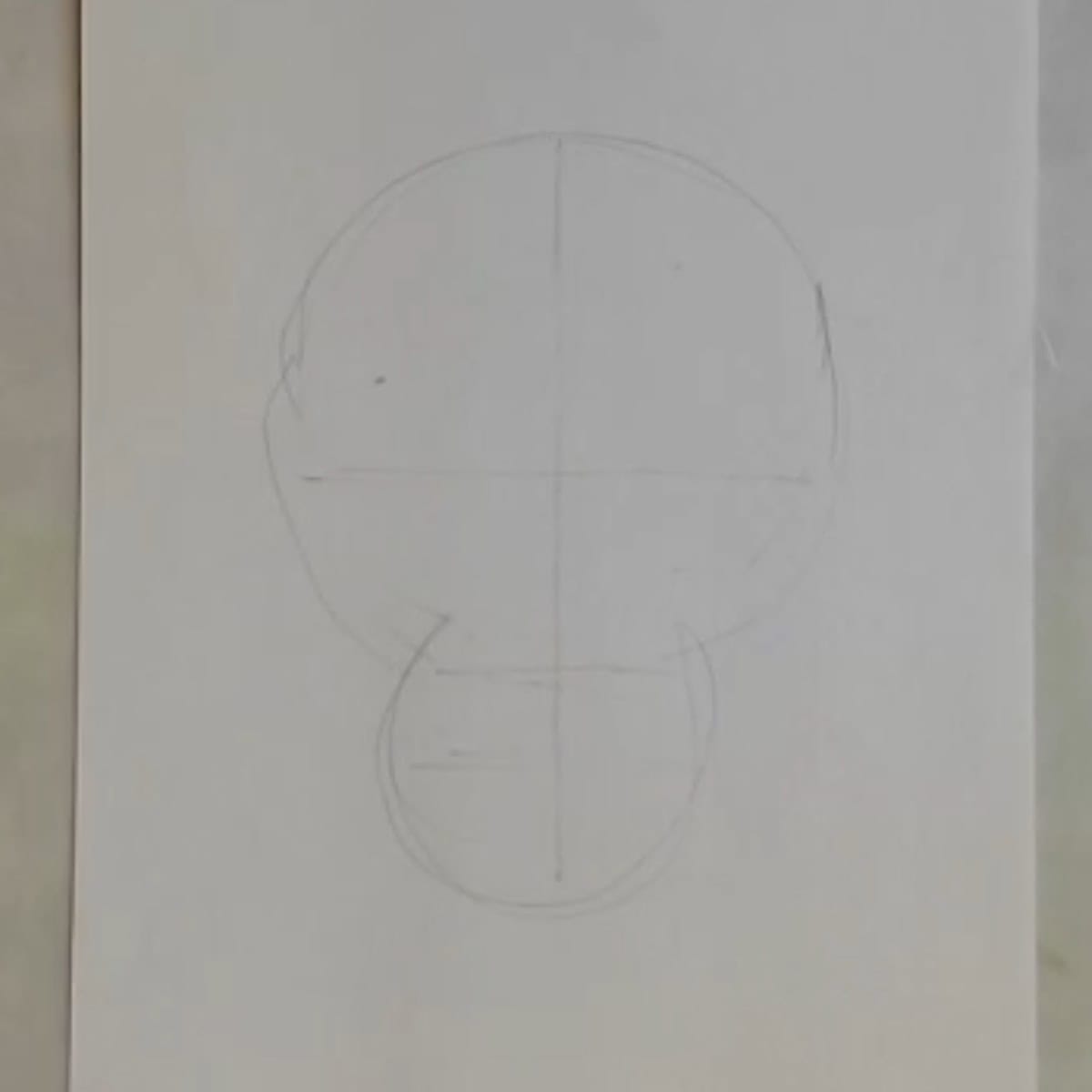
    Beginning sketch of a skull.
    Sketch two circles and guidelines
    Beginning drawing of a skull with eyes and nose sketched in.
    Add the eyes and nose
    • Sketch a circle with an HB or 2B Pencil. Then draw a smaller circle below the first. Erase the lines where they overlap.
    • Draw a guideline down the center of the skull. Add a guideline halfway between the top and bottom of the head where the eye sockets will go. Sketch a guideline halfway between to the bottom of the jaw, for the nose. Lastly, add a line halfway between the nose and chin, for the mouth.

    Add the eyes, nose, and define the bones
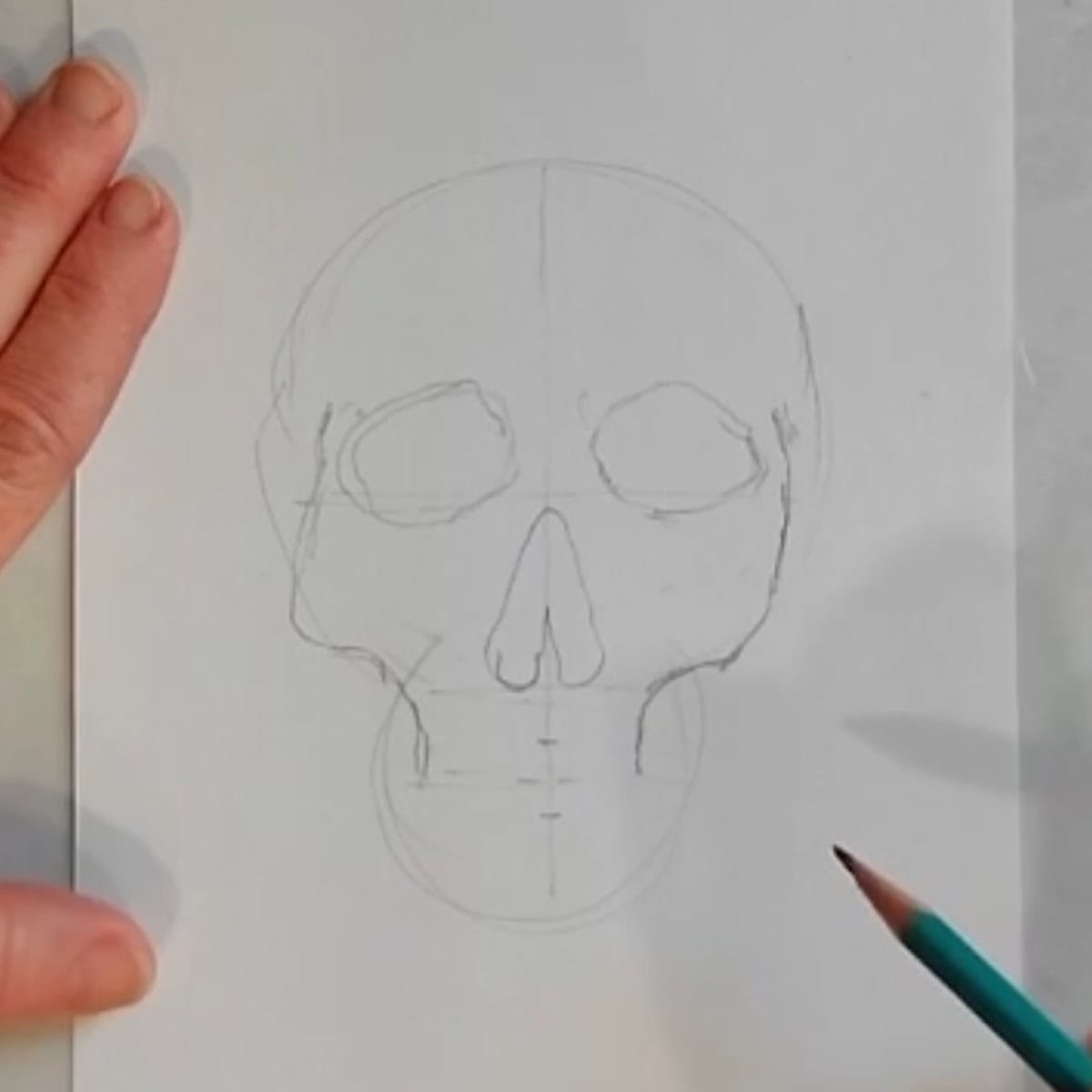
    Beginning sketch of a skull with artist drawing in cheekbones with a pencil.
    Sketch in the cheek bones
    Beginning drawing of a skull with more details in jaw and head.
    Draw the jaw and top of skull
    • Sketch in the eye sockets. They are roughly oval shapes but tilted to the side.
    • Sketch in the nose. It is an upside-down heart shape that is rounded on the top. Leave some of the division between the two nasal cavities visible.
    • Sketch in the facial bone beginning near the eye sockets. Draw the cheekbones and then sketch in and down for the front part of the teeth. The cheekbones will line up roughly with the bottom of the nose.
    • Draw the back part of the jaw from the cheekbone down to the chin. Draw the inner part of the jaw from the cheek and curve it down to meet the center of the mouth. 
    • Sketch in a rounded mandible joint, most of it is covered up from the front view, so it is just a rounded bump in the back of the jaw.
    • Sketch in a few lines to indicate the dips behind the eyes. 

    Draw the mouth and teeth
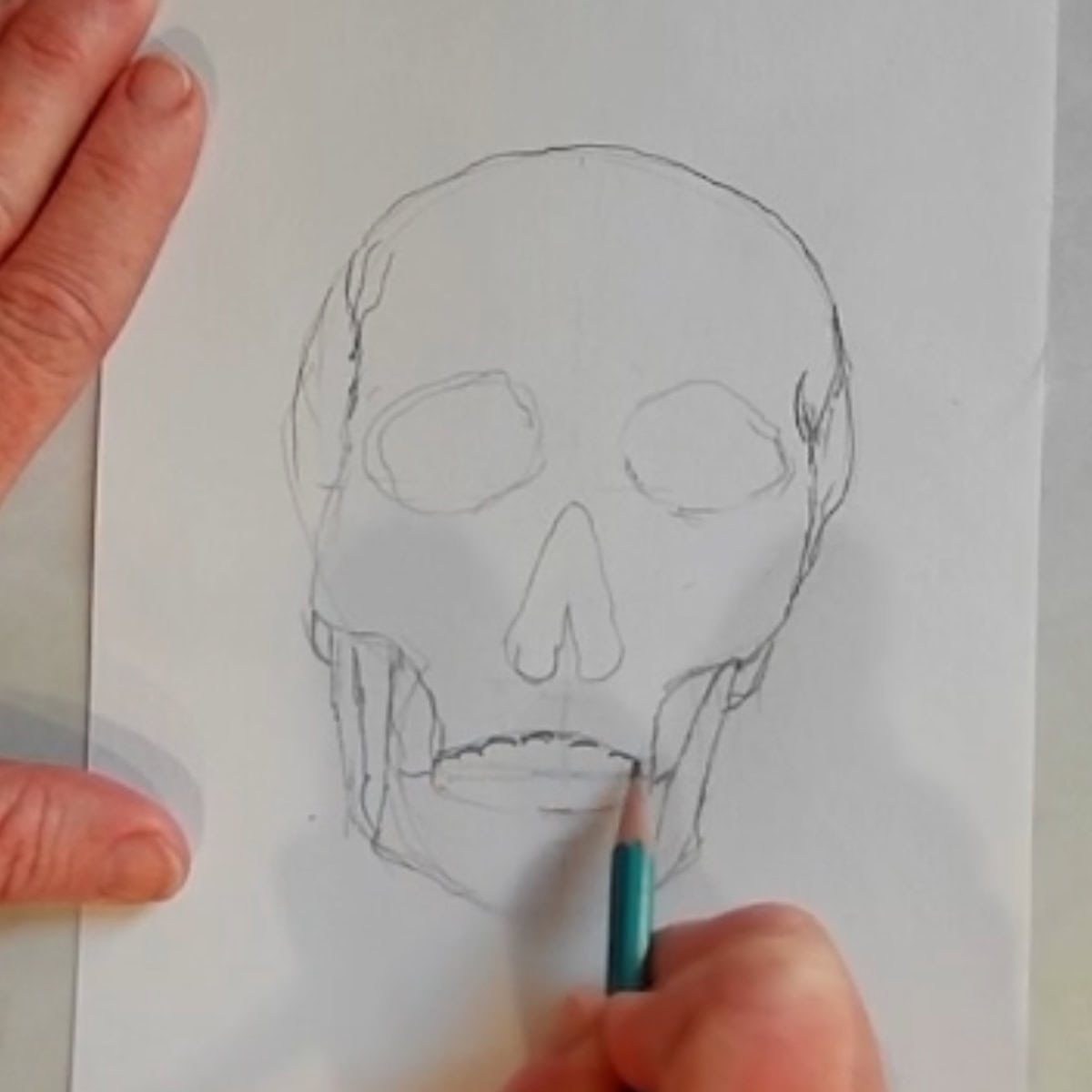
    Beginning drawing of a skull with artist drawing in the mouth with a pencil.
    Sketch the mouth shape
    Beginning sketch of a skull with artist drawing in the teeth with a pencil.
    Draw the teeth
    • Sketch in the mouth. Draw a curved line for both the bottom and top teeth. The top teeth will be larger than the bottom row. 
    • Starting with the top teeth, draw a small curve for the top of each tooth. The teeth will be smaller toward the back of the mouth. Three or four teeth should fit on each side.
    • Repeat this process for the bottom teeth. The top teeth cover the tops of the bottom teeth so no need to draw the tops, just draw in the sides. Shade in between the teeth.

    Shade in the dark areas

    Beginning drawing of a skull with artist shading in dark areas with a pencil.
    Shade in the darker areas
    Drawing of a skull with artist drawing loose lines for shading  in the front of the face in pencil.
    Use loose sketchy lines to shade
    • Using the softer pencil, shade in the eye sockets, nose cavity, in between the jaw, and the digits behind the eyes. Go over them several times if necessary to give them very dark value.
    • Add loose sketchy lines for more texture and detail
    • Using loose sketchy lines, add some texture over the rest of the skull. Follow the natural lines and flow of the form, under and around the eyes, above and below the teeth, and roundness at the top of the skull. 
    • Darker values tend to come toward the viewer so make sure to add some value to the top of the skull and back of the jaw but do not make them too dark. The darkest areas should be the eyes, nose, and the space between the jaw.

    Add the final details and touches

    Drawing of a skull with artist drawing loose lines for shading on the chin in pencil.
    Draw loose lines on chin and top of skull
    Finished drawing of a skull with with pencil shading under the skull.
    Add cracks & a shadow under
    • You can add in a few irregular squiggly lines for cracks in the bone if you want.
    • Look over the whole drawing and make any adjustments. If any areas need brightening, use an eraser on them, if any areas need darkening, add more value. Add more details, if needed.
    • Lastly, shade in a dark shadow on the bottom of the skull to show is sitting on a table or some kind of surface. Soften the edge of the shadow with a bit of lighter value. 

    Tips and tricks

    • Turn your paper as needed to make the sketching and shading easier.
    • Keep your shoulder and arm loose to get nice sketchy lines, don’t tense your muscles.
    • Darker values tend to come toward the viewer so make sure to add some value to the top of the skull and back of the jaw but doo not make them too dark. The darkest areas should be the eyes, nose, and then space between the jaw.
    • Concentrate on drawing where you see the light and dark values of the skull.

    Detailed Instruction Card for Drawing a Skull

    Drawing of a skull in pencil next to drawing pencils and an eraser.

    How to Draw a Skull Step by Step

    Learn how to draw a skull step-by-step in this easy tutorial. In this simple online art class find out how to sketch a realistic skull in pencil. A perfect art lesson for beginners or advanced artists, this lesson easily teaches how to draw a skull one step at a time. It is fun to practice drawing a human skull and explore new art skills and techniques at the same time.
    Facebook Pinterest Email Print

    Equipment

    • Pencils (HB for 2B or light sketching and 9B or other soft, dark pencil for shading)
    • Paper - 70 pound / 115 gsm. drawing paper 9 x 6 inches (or use whatever you have on hand)
    • Eraser - white vinyl or other

    Instructions

    Sketch the basic shape and guidelines

    • Sketch a circle with an HB or 2B Pencil. Then draw a smaller circle below the first. Erase the lines where they overlap.
    • Draw a guideline down the center of the skull. Add a guideline halfway between the top and bottom of the head where the eye sockets will go. Sketch a guideline halfway between to the bottom of the jaw, for the nose. Lastly, add a line halfway between the nose and chin, for the mouth.

    Add the features

    • Sketch in the eye sockets. They are roughly oval shapes but tilted to the side.
    • Sketch in the nose. It is an upside-down heart shape that is rounded on the top. Leave some of the division between the two nasal cavities visible.
    • Sketch in the facial bone beginning near the eye sockets. Draw the cheekbones and then sketch in and down for the front part of the teeth. The cheekbones will line up roughly with the bottom of the nose.
    • Draw the back part of the jaw from the cheekbone down to the chin. Draw the inner part of the jaw from the cheek and curve it down to meet the center of the mouth.
    • Sketch in a rounded mandible joint, most of it is covered up from the front view, so it is just a rounded bump in the back of the jaw.
    • Sketch in a few lines to indicate the dips behind the eyes.

    Draw the mouth and teeth
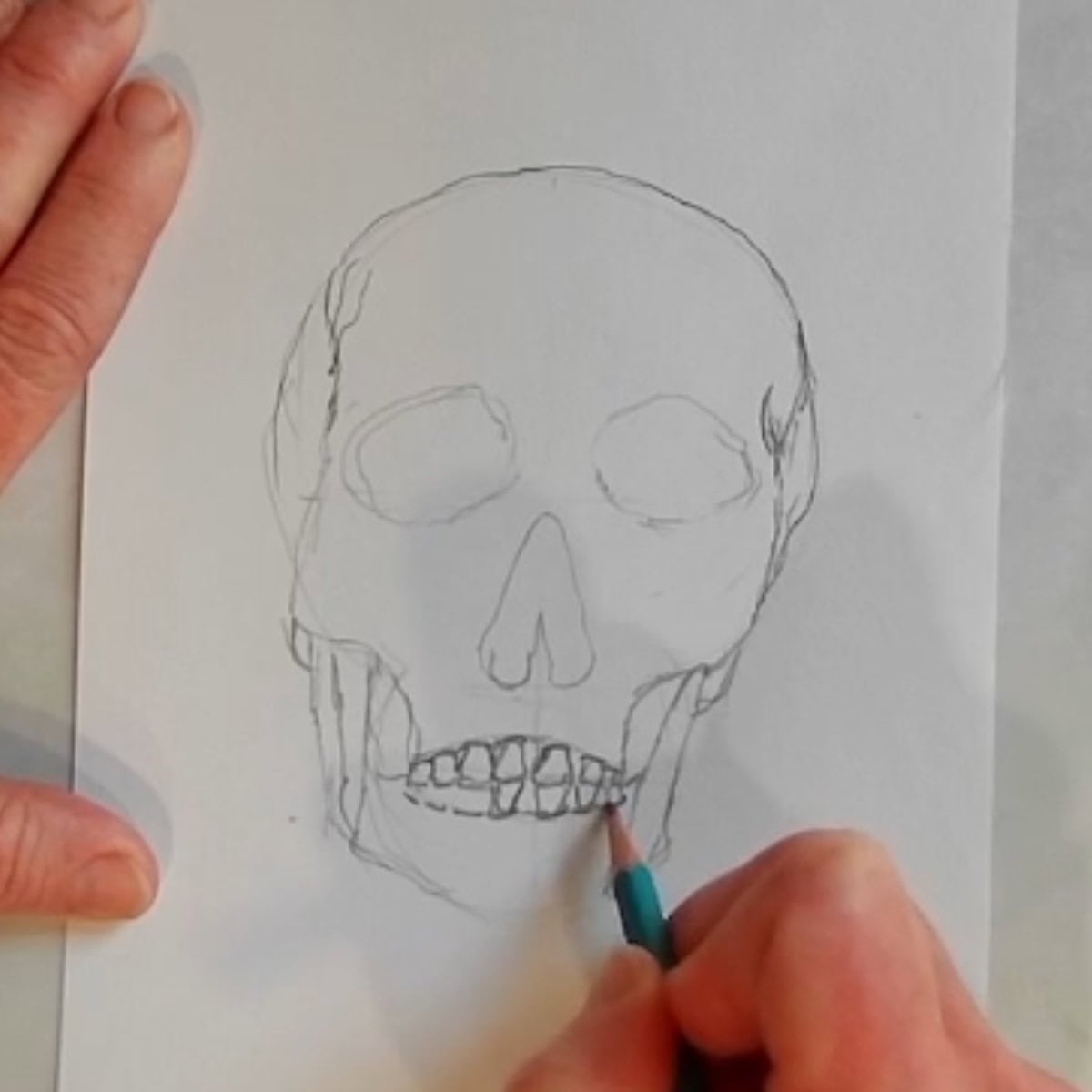
    • Sketch in the mouth. Draw a curved line for both the bottom and top teeth. The top teeth will be larger than the bottom row.
    • Starting with the top teeth, draw a small curve for the top of each tooth. The teeth will be smaller toward the back of the mouth. Three or four teeth should fit on each side.
    • Repeat this process for the bottom teeth. The top teeth cover the tops of the bottom teeth so no need to draw the tops, just draw in the sides. Shade in between the teeth.

    Shade in the dark areas
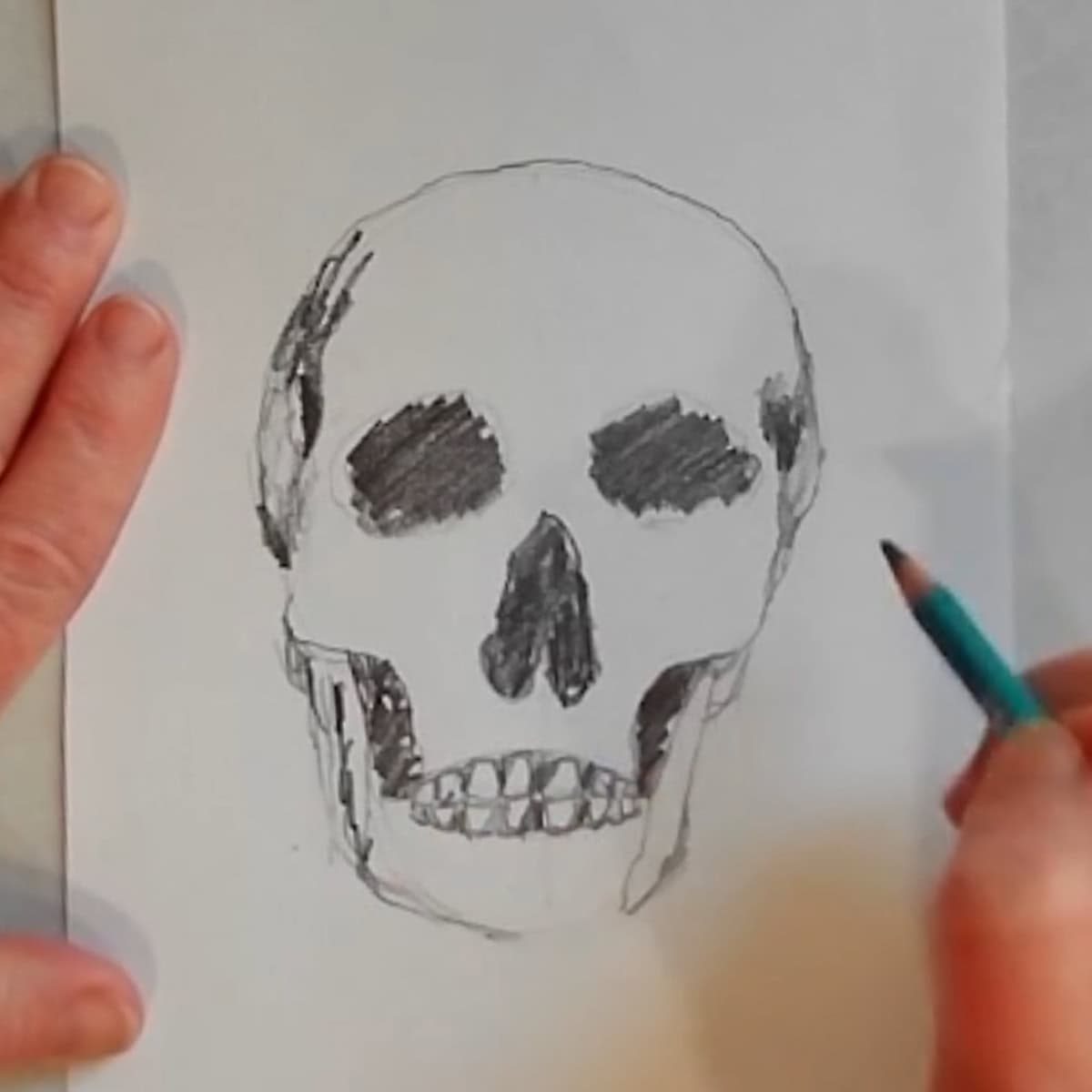
    • Using the softer pencil, shade in the eye sockets, nose cavity, in between the jaw, and the digits behind the eyes. Go over them several times if necessary to give them very dark value.
    • Add loose sketchy lines for more texture and detail
    • Using loose sketchy lines, add some texture over the rest of the skull. Follow the natural lines and flow of the form, under and around the eyes, above and below the teeth, and roundness at the top of the skull.
    • Darker values tend to come toward the viewer so make sure to add some value to the top of the skull and back of the jaw but do not make them too dark. The darkest areas should be the eyes, nose, and the space between the jaw.

    Add the final details and touches
    • You can add in a few irregular squiggly lines for cracks in the bone if you want.
    • Look over the whole drawing and make any adjustments. If any areas need brightening, use an eraser on them, if any areas need darkening, add more value. Add more details, if needed.
    • Lastly, shade in a dark shadow on the bottom of the skull to show is sitting on a table or some kind of surface. Soften the edge of the shadow with a bit of lighter value.

    Notes

    • Turn your paper as needed to make the sketching and shading easier.
    • Keep your shoulder and arm loose to get nice sketchy lines, don’t tense your muscles.
    • Darker values tend to come toward the viewer so make sure to add some value to the top of the skull and back of the jaw but doo not make them too dark. The darkest areas should be the eyes, nose, and then space between the jaw.
    • Concentrate on drawing where you see the light and dark values of the skull.

    For More Practice

    • Find a photo of a skull online and practice drawing from the image.
    • Practice drawing a skull from a different point of view. Try a side view, three-quarters view looking down from the top.
    • Draw a skull using colored pencils, charcoal, pen and ink, or another medium.
    • Sketch in the basic outline of the skull. Instead of shading it with pencil, paint it with watercolor paint. Get creative with the color!
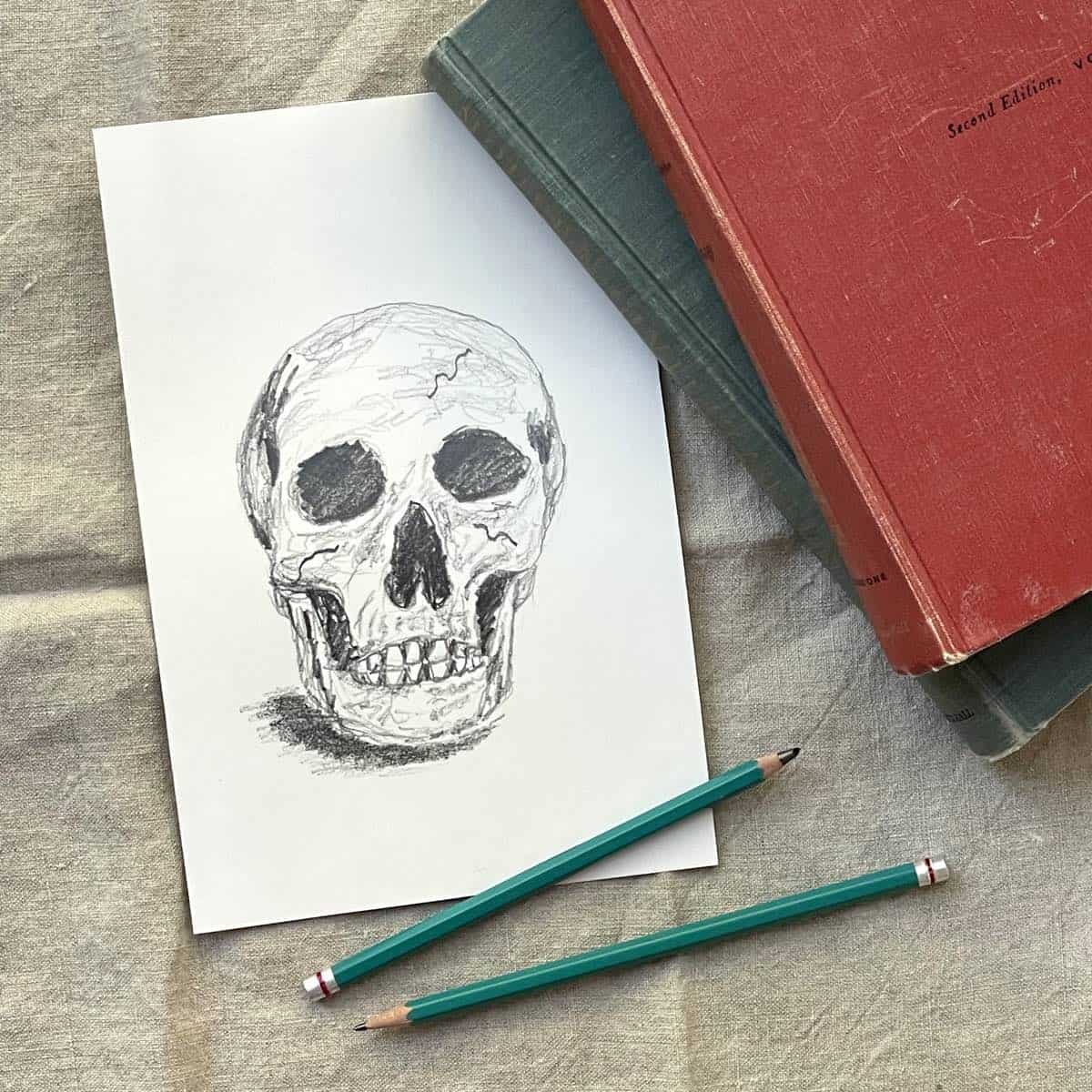
    Skull drawing next to books and drawing pencils on a beige table cloth.

    How to Download an Image from the Internet

    I recommend getting an image of a skull to practice drawing from. You can find images in magazines such as National Geographic and Smithsonian or from the internet. 

    To download an image from the internet right click on the image with your mouse. A box will pop up. Scroll down to “save image as”. Click on that and it will allow you to save it on your computer for reference. 

    If you are using an older Mac, push the keyboard’s command button and click on the mouse at the same time. Then select “save as” and choose the location to save on your computer.

    Frequently Asked Questions

    How to draw a skull easily?

    To draw a skull easily, focus on the overall shape. Sketch the basic shape, add the features, draw the mouth and teeth, shade in the dark areas, and add sketchy lines for more texture and detail.

    Do you need to know anatomy to draw a skull?

    No, absolutely not! All you need to draw a skull is a photo image for referral. Then sketch the basic outline, draw in the features, and shade the lights and darks. You can also follow along with this great video tutorial here at Artlooklearn.com.


    How do you draw a realistic skull?

    To make your skull more realistic take your time drawing it. Find a photo of a skull to use as a reference for your drawing. Start with a basic sketch of the entire skull then add more detail gradually. Concentrate on the lights and ears of what you see. Use smooth pencil shading to get fluid transitions between the light and dark areas.
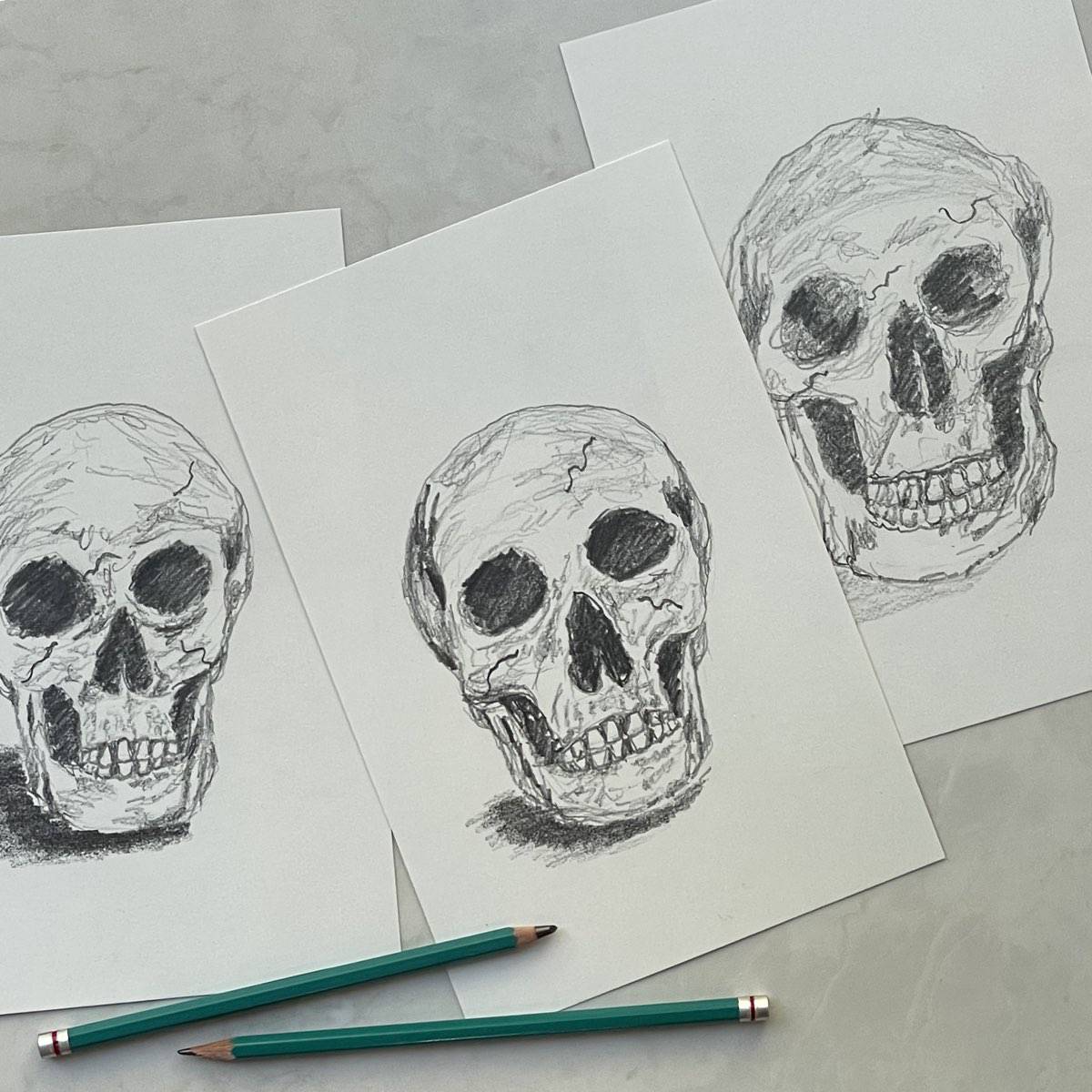
    Three sketchy drawings of skulls next to artist drawing pencils.

    You also might like

    • How to Draw a Sphere and Shade It In
    • Paint Colorful Fall Leaves
    • Watercolor Paint an Easy Pumpkin

    Please leave your questions, comments, and ratings below!
    More Beginning Drawing Lessons Online

    • A pencil drawing of an eye on a sketchbook with drawing pencils next to colored pencil drawing of eyes.
      How to Sketch a Simple Eye Step-by-step Drawing Tutorial
    • Pencil drawing of a realistic turkey with several watercolor paintings of turkeys with drawing pencils, an eraser, and a pencil sharpener.
      How to Draw a Real Thanksgiving Turkey Easy Step-by-step
    • Pencil drawing of fall leaves on a sketch pad next to watercolored paintings of fall leaves with drawing pencils and eraser.
      Draw Easy Fall Leaves Step-by-step (Realistic Autumn Leaf Sketch)
    • Simple Ocean Drawing Tutorial (Easy Pencil Seascape Sketch)

    Leave a Reply Cancel reply

    Your email address will not be published. Required fields are marked *

    • Facebook
    • Instagram
    • Mail
    • YouTube
    • Pinterest

    Most Popular Online Art Classes

    • Drawing paper, sketchpads, drawing pencils and eraser
      Best Types of Paper for Drawing, Sketching and Other Art
    • Pencil drawing of fall leaves on a sketch pad next to watercolored paintings of fall leaves with drawing pencils and eraser.
      Draw Easy Fall Leaves Step-by-step (Realistic Autumn Leaf Sketch)
    • spheres created in pencil, watercolor paint and soft pastels with paints, paint brushes and drawing pencils
      How to Draw a Sphere in 3d
    • Drawing of a coffee mug in pencil with colored pencil drawings in the background.
      How to Draw a Coffee Mug (Cup Sketch) Beginning Drawings

    Best Spring Art Projects

    • Painting of a watercolor lake scene with trees, a hill and reflections on the water next to paint brushes and a watercolor palette.
      Paint an Easy Watercolor Lake Scene Step-by-step
    • A pencil drawing of an eye on a sketchbook with drawing pencils next to colored pencil drawing of eyes.
      How to Sketch a Simple Eye Step-by-step Drawing Tutorial
    • Drawing and watercolor painting of oak trees with drawing pencils and paint set.
      Sketch an Easy Oak Tree Pencil Drawing
    • Watercolor painting of pansies that show examples of watercolor painting techniques for beginners next to a palette and paintbrush.
      Easy Watercolor Techniques for Beginners 
    Sam - Art Instructor

    Hi, I'm Sam! Creating is a journey. While learning basic skills is important, the process of making is much more important than the finished project. Experiencing hands on drawing, painting and other art activities is fulfilling and enlightening.

    More about me →

    Footer

    ↑ back to top

    Copyright © 2025 ARTLOOKLEARN.COM