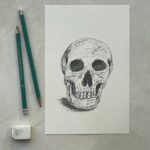
How to Draw a Skull Step by Step
Learn how to draw a skull step-by-step in this easy tutorial. In this simple online art class find out how to sketch a realistic skull in pencil.
A perfect art lesson for beginners or advanced artists, this lesson easily teaches how to draw a skull one step at a time. It is fun to practice drawing a human skull and explore new art skills and techniques at the same time.
Facebook
Pinterest
Email
Print
Equipment
- Pencils (HB for 2B or light sketching and 9B or other soft, dark pencil for shading)
- Paper - 70 pound / 115 gsm. drawing paper 9 x 6 inches (or use whatever you have on hand)
- Eraser - white vinyl or other
Instructions
Sketch the basic shape and guidelines
- Sketch a circle with an HB or 2B Pencil. Then draw a smaller circle below the first. Erase the lines where they overlap.
- Draw a guideline down the center of the skull. Add a guideline halfway between the top and bottom of the head where the eye sockets will go. Sketch a guideline halfway between to the bottom of the jaw, for the nose. Lastly, add a line halfway between the nose and chin, for the mouth.
Add the features
- Sketch in the eye sockets. They are roughly oval shapes but tilted to the side.
- Sketch in the nose. It is an upside-down heart shape that is rounded on the top. Leave some of the division between the two nasal cavities visible.
- Sketch in the facial bone beginning near the eye sockets. Draw the cheekbones and then sketch in and down for the front part of the teeth. The cheekbones will line up roughly with the bottom of the nose.
- Draw the back part of the jaw from the cheekbone down to the chin. Draw the inner part of the jaw from the cheek and curve it down to meet the center of the mouth.
- Sketch in a rounded mandible joint, most of it is covered up from the front view, so it is just a rounded bump in the back of the jaw.
- Sketch in a few lines to indicate the dips behind the eyes.
Draw the mouth and teeth
- Sketch in the mouth. Draw a curved line for both the bottom and top teeth. The top teeth will be larger than the bottom row.
- Starting with the top teeth, draw a small curve for the top of each tooth. The teeth will be smaller toward the back of the mouth. Three or four teeth should fit on each side.
- Repeat this process for the bottom teeth. The top teeth cover the tops of the bottom teeth so no need to draw the tops, just draw in the sides. Shade in between the teeth.
Shade in the dark areas
- Using the softer pencil, shade in the eye sockets, nose cavity, in between the jaw, and the digits behind the eyes. Go over them several times if necessary to give them very dark value.
- Add loose sketchy lines for more texture and detail
- Using loose sketchy lines, add some texture over the rest of the skull. Follow the natural lines and flow of the form, under and around the eyes, above and below the teeth, and roundness at the top of the skull.
- Darker values tend to come toward the viewer so make sure to add some value to the top of the skull and back of the jaw but do not make them too dark. The darkest areas should be the eyes, nose, and the space between the jaw.
Add the final details and touches
- You can add in a few irregular squiggly lines for cracks in the bone if you want.
- Look over the whole drawing and make any adjustments. If any areas need brightening, use an eraser on them, if any areas need darkening, add more value. Add more details, if needed.
- Lastly, shade in a dark shadow on the bottom of the skull to show is sitting on a table or some kind of surface. Soften the edge of the shadow with a bit of lighter value.
Notes
- Turn your paper as needed to make the sketching and shading easier.
- Keep your shoulder and arm loose to get nice sketchy lines, don’t tense your muscles.
- Darker values tend to come toward the viewer so make sure to add some value to the top of the skull and back of the jaw but doo not make them too dark. The darkest areas should be the eyes, nose, and then space between the jaw.
- Concentrate on drawing where you see the light and dark values of the skull.