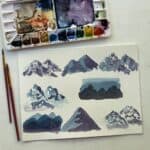
Watercolor Paint Mountains Step By Step (8 Easy Techniques)
Learn how to watercolor paint mountains step-by-step using 8 easy techniques in this art lesson. This beginning watercolor painting lesson will help you understand different ways of painting a mountain.
Facebook
Pinterest
Email
Print
Equipment
- Watercolor paper - I am using 9 by 12 inch Strathmore Vision cold press 140 lb. watercolor paper
- Watercolor paint - tube watercolor paint on a pallet or a box kit of watercolor paints.
- Paint brushes - I am using a #8 round and #4 round
- Water
- Paper towels
Instructions
Dry Brush
- Lightly sketch in a mountain shape. Use a dry brush and pick up a small amount of blue paint at a time. Use the side of the paintbrush to lightly brush the paint onto the mountain. Allow some white to show through the paint.
- Pick up a small amount of purple or darker-colored paint and use the same technique on one side of the mountain to indicate shadows. When it is dry, erase the pencil lines.
Wet on Wet
- Load up the brush with blue paint and paint in several mountains. While the paint is still damp add some purple paint on one side of the mountains for the shadows. When it dries the colors will blend together slightly for a misty effect.
Daubs and Saran Wrap
- Lightly sketch in a mountain shape. Use clean water to dampen each section of the mountain separately. Paint daubs of blue paint over both areas. Add daubs of dark purple paint on one side of each peak for shadows.
- Crumple up a piece of saran wrap, large enough to fit over your mountain. Carefully place it over the area, making sure it has contact with the paint.
- When it is dry remove the saran wrap and erase the pencil lines. This will give you a unique rocky texture, resembling jagged edges. This technique also works well with a variety of different colors.
Layering
- Water down some of the blue paint. Use this to paint in several mountain and valley shapes. Let it dry.
- Use the middle tone blue paint to paint another layer of mountains in front of the first layer. Let this layer dry as well.
- Finally, paint some dark purple mountains in the foreground.
- Using this technique, add as many different layers as you want. Just make sure to place the lighter colors I the background and darker ones in the foreground.
Two-Tone Triangle
- Lightly sketch in a triangle-shaped mountain peak. Then sketch in a squiggly line that zig-zags down the mountain and then swoops off to one side.
- Paint the entire mountain with the middle tone blue. After it dries, paint dark purple on one side of the mountain, following the zig-zag line. Erase any pencil lines showing when it is dry.
Lines and Washes
- Using loose strokes, paint a triangle-shaped mountain peak using the tip of the brush. Paint a loose squiggly line zig-zagging down from the top. These can be irregular strokes with breaks in between the lines.
- Rinse out your brush. Then using the pigment that is already on the paper, draw out the paint into transparent washes. Repeat the process by adding some lines in dark purple, cleaning the brush, and then creating washes.
- Paint each mountain peak separately using lines and washes.
Silhouette
- Use the blue paint to paint the sky. The sky is usually lighter near the horizon line and darker higher in the sky. (Oops! In the demo, I painted the gradient in the opposite direction. Lol. Good thing it did not affect the mountain silhouette.) Blend out the paint toward the horizon line.
- After the sky is dry, use a very dark mixture of black blue and crimson to paint in a silhouette of a mountain range. Make the edges slightly squiggly to indicate trees or rocks, or just make them straight.
Free Form Mountain Range
- Paint in the darker shapes on the mountain. Clean the brush and then use some of the paint on the paper to pull out the paint into thinner washes. Make sure to leave some areas of white.
- Add in some areas of dark purple on one side of the peak for shadows. Pull out some of the purple paint into transparent washes. Paint each peak or section of the mountain separately.
- This is a great technique to use if you are looking at a mountain or a photo of one. Concentrate on depicting the areas of lights and darks.
Notes
Imagine the light source hitting the mountain in a certain direction. If the sun is shining in from the left side, the shadows will primarily be on the right side of each mountain peak.
Be aware of how much water you are using. The techniques can vary greatly depending on how wet or dry the paper is or how much pigment is concentrated in the paint mixture.
Use lighter colors in the distance and darker colors in the foreground to create a greater sense of dimension in the painting.
Play around with these different approaches. Don’t be afraid to combine the techniques in new ways. Building up layers and textures can add whole new dimensions to your paintings.
Since you are practicing, don’t forget that you can use both sides of your watercolor paper.
You can also experiment with leaving some of the layers a little damp when painting in the next layer. This can give you some interesting texture and blending.
You can also experiment with leaving some of the layers a little damp when painting in the next layer. This can give you some interesting texture and blending.