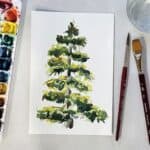
How to Paint a Pine Tree Easy in Watercolor
Learn how to paint a pine tree easy in watercolor with this art lesson. Discover the simplest technique to paint a beautiful evergreen tree quickly. Keep the paint strokes loose and irregular when practicing painting this tree.
Facebook
Pinterest
Email
Print
Equipment
- Watercolor paper - I am using Strathmore 400 Series, cold press, watercolor paper, 140 lb., cut down to 9 by 6 inches
- Watercolor paint - tube watercolor paint on a pallet or a box kit of watercolor paints. You can use whatever colors that you have on hand. For this lesson I use: Cadmium Yellow,
- Prussian Blue, Black, Burnt Umber, and Cadmium Red Light
- Paint brushes - I am using a #8 round brush.
- Water
- Paper towels
Instructions
- Mix cadmium yellow, Prussian blue, and a little bit of black paint. Paint the basic structure of the pine tree. Paint with me, look at a real tree, or a photo of a tree to get a sense of where the lights and darks are.
- Use black and burnt umber to create the trunk. Paint the right side of the trunk in between the branch clusters. Rinse out the brush and then drag the paint from the right across to the left side of the trunk to create a highlighted effect.
- Combine a small amount of Prussian blue with cadmium yellow to make a very light green. Use this to paint in some highlights, concentrating mostly on the top part of the branches.
- Then mix a little cadmium yellow, Prussian blue, and black paint to make dark green. Paint in some shadows, concentrating mostly on the underside of branches.
- Add a black shadow on the right side of the trunk. Slightly blend it into the brown already on the trunk.
- Slightly water down some of the brown-black paint mixture and use it to paint in a few branches and twigs. Do not paint in every single branch, just a few hints of them here and there.
- If you like, leave your tree like this. To add more texture, value and contrast you can add another round light, middle and dark paint.
- Use the light green to add a few more overlapping highlights.
- Add some more middle green in several areas around the tree.
- Paint in some shadows around the branches, concentrating on larger dark areas.
- Lastly, a few small dabs of red paint in a few areas. When we see objects, such as trees, they are composed of many different colors, all working together. Try squinting the next time you look at a tree. Identify how many different colors you can see.
Notes
- Keep the paint strokes loose and irregular.
- Avoid painting the branches in a pattern.
- The paint will dry lighter than when it is wet.
- Trees are usually not perfect triangles in nature. They are often lopsided and with more branches in some areas and twigs sticking out here and there. Let your painting reflect the irregularities.
- When we see objects, they are composed of many different colors, coming together to give the impression of a solid object. Try squinting the next time you see a tree. How many different colors can you identify?