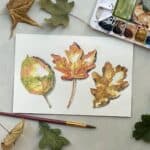
Paint Colorful Autumn leaves (Easy Watercolor Tutorial)
Learn how to paint colorful autumn leaves in this easy watercolor tutorial. In this simple online art class find out how to create three different types of leaves and the best way to color them. Painting fall leaves is fun for everyone, from kids to adults. Autumn leaf painting is great practice for beginners and those with more art experience.
Facebook
Pinterest
Email
Print
Equipment
- Watercolor paper I am using Strathmore Vision cold press watercolor paper, 140 lb., cut down to 6 by 9 inches
- Watercolor paint - tube watercolor paint on a pallet or a box kit of watercolor paints. You can use whatever colors that you have on hand, these are the colors that I use: Cadmium Yellow, Cadmium Red Light, Ultramarine Blue, Alizarin Crimson, Yellow Ocher, Burnt Sienna, Burnt Umber, Black
- Paint brushes - I am using a #8 round brush.
- Water
- Paper towels
Instructions
Sketch in the leaves
- Sketch in your leaves by looking at them or placing them on the paper and tracing around the outside. Only trace one side of the stem and then draw in the other side by hand or it will be too thick.
- Paint using the lightest colors first and then move on to the darker colors. Paint one leaf at a time, work quickly while the first layer of paint is still damp.
Paint the first leaf
- Fill in most of the leaf with light yellow paint. Leave a small area white where light is shining on it.
- Mix yellow and blue paint to make bright green. Add the green paint to several areas of the leaf, painting over the top of the yellow tone. Make sure to leave plenty of yellow showing.
- Rinse out the paintbrush and dry the excess on a rag or paper towel. With the clean damp brush soften the edges of the green paint where it meets the yellow.
- Make sure not to over-blend the colors, just soften the edges a little bit.
- Daub on a few areas of red and then soften the edges with a clean damp brush.
Paint the second leaf
- Paint the leaf with yellow paint, leaving several small white areas.
- Add a few areas of red paint to the maple leaf, concentrating mostly on the outside edges of the leaf.
- Then use crimson paint to add more bright color to the leaf in a few areas.
- Clean the paintbrush and soften the edges of the different colors where they meet.
Paint the third leaf
- Fill in the last leaf with yellow paint except for a small white reflection area.
- Use yellow ocher to begin adding the layers of color. Follow this by adding daubs of burn Sienna and finally burnt umber.
- Where the colors join, gently soften the edges using a clean, damp paintbrush.
Add the veins
- Paint in a few veins in each leaf after they are slightly dry. Damp paper is ok but make sure there is no paint sitting on top of the surface.
- Using watered-down dark brown paint, push very lightly with the brush to just paint with the tip. Do not add too many veins, just a few lines give a nice impression.
- Twist the paintbrush slightly as you paint to create an irregular, organic-looking line. Do not add veins in the white reflected areas.
Paint the shadows
- Adding shadows is optional but I love the look of the shadow and it grounds the leaf within the space of the page.
- Add black paint to the right and bottom areas of the leaves. Rinse out the paintbrush and then blend the paint away from the leaf. Soften the edge of the shadow by gently painting over it again with a damp brush.
- When it is dry, erase any pencil lines that show through.
Notes
- Trace around the outside of the leaf for a quick sketch. Only trace one side of the stem and then draw in the other side by hand or it will be too thick.
- Paint the lightest colors first then move on to the darker colors.
- Paint one leaf at a time and work quickly while the first layer of paint is still damp.
- Make sure not to over-blend the different colors as you add them. Just soften the edges a little bit where they meet.