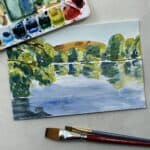
Paint an Easy Watercolor Lake Scene Step-by-step
Learn how to paint an easy watercolor lake scene step-by-step in this online art lesson. Complete with trees, and reflections on water this painting video tutorial for beginners is simple and fun to create.
Facebook
Pinterest
Email
Print
Equipment
- Watercolor paper I am using 140 lb. Strathmore Vision cold press watercolor paper cut down into a 6 x 9-inch piece.
- Watercolor paint - tube watercolor paint on a pallet or a box kit of watercolor paints. Don’t worry if you don’t have the same colors, you can use whatever you have on hand. I use: Cerulean Blue, Yellow Ocher, Viridian green, Black, Cadmium Yellow, Ultramarine blue, Burnt umber, Burnt Sienna , Alizarin Crimson
- Paint brushes I am using #4 round, 3/4 inch flat
- Water
- Paper towels
Instructions
Sketch
- Sketch the lake scene very lightly. Make sure the lines are light enough they will not show through the paint. Don’t add a lot of detail, focus on drawing the basic shapes.
Paint the sky and hill
- Paint the sky with cerulean blue. It is ok if you overlap into the trees a tiny bit. Let the sky dry slightly before painting the hill otherwise, the colors may bleed into each other.
- Use yellow ocher paint to color the hill in the distance. Use burnt umber to add a few darker details in this area.
Add greens and yellows in the trees
- Mix viridian green, yellow, and a small amount of black and paint it in the middle-toned area of the trees. Remember to paint the tree in the foreground.
- Paint a light yellowish green into the light areas of the trees where the sunlight is hitting. This is mainly on the top and right side of the trees.
- Mix a small amount of black and green. Use this color to paint in the darker areas of the trees. The shadows are mainly on the left and bottom of the shapes.
- Repeat adding another layer of paint and texture to the trees in each of the three areas using middle green, yellow, and dark green.
- Paint ultramarine blue into some shadows.
Paint the water
- Use ultramarine blue to paint the water. Leave a thin white line between the edge of the trees and the lake. Add more paint to the water in the foreground and less pigment as it recedes into the distance.
- Leave a few slivers of white in the water to indicate ripples. Dab the paint on for some added texture and movement in the water.
- Use a clean brush to lift off some of the color, if desired. This will add a few more white horizontal lines for ripples.
Add the reflections
- Paint a mirror image of the trees above, leaving horizontal strips of water showing through. Add in the reflections while the blue paint of the water is still damp.
- Use the middle-tone green in the center of the reflections, yellow on the right, and the green-black mix on the left.
- Dab some ultramarine blue into the shadows where it appears above.
- Paint a mixture of black, blue, and green in the water directly below the tree in the foreground, leaving some strips of water peaking through.
Paint the final details
- Use Alizarin Crimson, or red to add just a few dabs of color in the trees and reflections.
- Paint the tree branch in the foreground using burnt Sienna or brown.
- Add a thin broken line at the base of the trees to indicate the ground using burnt Sienna. Leave the white line between the brown line and the beginning of the water.
Notes
Use a 2B pencil or other hard light pencil to create the sketch and make the lines as light as possible.
Keep your strokes nice and loose. Relax your hand and arm when painting.
Avoid painting the reflections in a solid shape. Instead use horizontal strokes leaving strips of water in between.
To add a sense of depth in the painting make the colors in the foreground brighter and darker. Allow the colors in the distance to be lighter.